

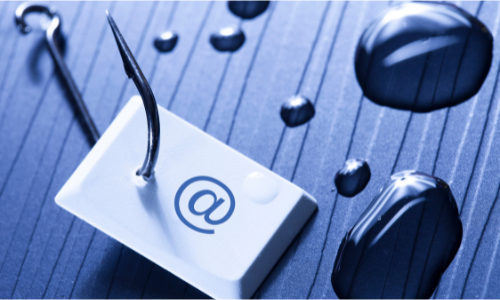
Phishing is a social engineering attack used to obtain sensitive information, such as login credentials and payment details, from users. It happens when an attacker, posing as a trusted source, dupes a victim into clicking on a malicious link or downloading a spam file sent over email, text messages, phone calls or social media. If you fall into this trap, you could end up with malware, system slowdowns and sensitive data loss, among other things.
The term phishing is one of the most reviled in today’s digital landscape and is a significant concern for executives. It’s no surprise that the word is frowned upon when the attack vector is responsible for more than 20% of data breaches.*
These attacks can be severely damaging for people and businesses. While individuals are affected by illicit purchases, financial fraud or identity theft, a company that is the victim of such an attack, in most cases, suffers severe financial losses as well as a loss of market share, reputation and stakeholder trust.
An unfortunate reality regarding phishing is that the attack vector is becoming more sophisticated and frequent with each passing day.
Why phishing attacks are becoming more frequent
- Remote/hybrid workforce
Over the last year and a half, a significant number of organizations had to transition to remote/hybrid work models. While the switch allowed operations to continue without interruption, the scattered workforce and mobile endpoints brought their own set of challenges. One of the main problems was vulnerabilities becoming more visible to hackers, who quickly exploited them through phishing attacks.
- Organizational oversights
Many businesses, in efforts to stay afloat amid the global crisis, completely disregarded cybersecurity. This included decreased spending on security posture, a lack of employee training and much more. Such mistakes opened the door for cybercriminals.
- Constantly evolving cybercriminals
Keep in mind that hackers constantly strive to uncover and exploit even the tiniest flaws in your business. They’re constantly shifting their strategy, so you’re practically defending against a moving attacker.
Threat actors have recently targeted businesses via the website contact form, pretending to be legal authorities, saying that the company is not complying with the law and asking the organization to download a “report.”
- Cheap phishing tools
Several low-cost phishing tools are available on the dark web, allowing even non-technical people to become hackers.
How can businesses stay safe?
To avoid falling victim to phishing, all small and midsize businesses (SMBs) must be constantly vigilant. To keep your business safe, you must:
- Facilitate regular security awareness training to ensure that everyone is on the same page and that employees strictly adhere to relevant security requirements.
- Ensure that your IT infrastructure is up to date so that hackers cannot exploit unpatched/non-updated systems.
- Enforce strong password policies and create a system that prohibits anyone from evading them.
- Try and isolate vital infrastructure components as much as possible, so that everything doesn’t collapse like a house of cards after a breach.
- Conduct mock phishing drills to get data on your employees’ degree of alertness.
- Deploy an automated phishing detection solution that is powered by artificial intelligence.
Trying to guard against phishing on your own takes a lot of effort and resources, especially if you’re running a business. Collaborating with an expert like us relieves you of additional concern and responsibility. Contact us today to set up a consultation and we’ll handle the heavy lifting for you.
Furthermore, a technology audit can inform you if any of your IT components have risks that must be mitigated quickly. To help you through the process, we have created an infographic titled “Why Annual Technology Audits Are Essential.” Click here to view.
Source:
*Verizon DBIR
Recent Blog Posts...
Oct. 07, 2026
Could One Employee Put Your Credit Union at Risk? How to Build a Human Firewall
Oct. 07, 2026
Why Do Quarterly Technology Reviews Matter More Than Annual IT Planning for Credit Unions?
Oct. 07, 2026
7 Ways to Protect Your TruLinx Environment from Cyberattacks
Oct. 05, 2026
10 Questions Every Mid-Sized Organization Should Ask About Its Cybersecurity Program
Oct. 05, 2026
Cybersecurity Awareness Month: 10 Questions Every Credit Union Should Ask About Its Cybersecurity Program
- AI6
- Application Integration6
- Application Performance16
- Artificial Intelligence1
- Asset Management2
- Bandwidth Management8
- Business Continuity / Disaster Recovery41
- BYOD7
- Cloud58
- Collaboration18
- Communication20
- Compliance4
- Contact Center1
- Credit Unions19
- Cyber Liability Insurance2
- Cybersecurity44
- Dark Web1
- Hosted Phone47
- Hybrid Working2
- Internet7
- Internet of Things6
- IT Infrastructure26
- Managed Network Services20
- Managed Services19
- Microsoft Teams2
- Network Performance29
- Network Security34
- News11
- Phishing1
- Press Release2
- Ransomware1
- Risk Assessment3
- security2
- SIP Trunking3
- surveillance1
- Technology Audit3
- Telehealth3
- TruLinx9
- Uncategorized38
- Unified Communications51
- VoIP36
- Work From Home3